5 Key Takeaways from This Article
A crypto platform under transitional pressure
A crypto asset service provider approached Regulated United Europe seeking regulatory clarity ahead of MiCA's full enforcement — we guided them from unstructured operation to full MiCA-compliant authorization in the Netherlands within approximately 8 months.
The Netherlands was the strategic fit
The Netherlands was selected after a structured comparison of EU jurisdictions, driven by DNB's established crypto track record, the client's existing European operational ties, and the Netherlands' pragmatic approach to crypto regulation under the MiCA framework.
Dutch legal counsel led the filing
The project was led in collaboration with our external legal counsel, Dutch lawyer Daan H., who handled DNB correspondence, legal opinions, and in-country regulatory liaison throughout the authorization process.
We managed the full scope
We managed the full scope: jurisdiction analysis, corporate structuring, MiCA application preparation, whitepaper compliance review, regulatory correspondence, and post-authorization compliance setup.
The article uses redacted evidence
The client remains anonymous; corporate documents, regulatory correspondence, and application materials are included as redacted screenshots.
The file only works if the control model is real
MiCA review is strongest when the jurisdiction choice, governance documentation, and evidence pack are built as one operating model instead of separate drafting tasks.
From Fragmented Registrations to a Single MiCA Route
In late 2023, a crypto asset exchange platform approached Regulated United Europe after realizing that MiCA would end the comfort of patchwork national registrations. The business matched buyers and sellers of multiple cryptocurrencies and served retail and semi-professional users across six EU member states.
The immediate problem was not whether the business needed authorization. It did. The real question was how to turn a transitional, multi-jurisdiction setup into a single MiCA-compliant Crypto Asset Service Provider structure that could passport across the EU without losing commercial momentum.
That became the brief: map the activity, test the legal classification, choose the right home jurisdiction, and build an application package that could survive regulator review and still leave room for expansion.
What the Client Already Had
- An operating exchange with a proprietary matching engine
- Existing national registrations in the Czech Republic and Lithuania
- A two-person legal and compliance team
- Real users across several EU markets
- A commercial need for passporting rather than isolated national permissions
What the MiCA File Still Needed
- A single EU establishment point for the CASP application
- A whitepaper aligned with MiCA disclosure requirements
- Formal governance, capital, and control documentation
- A regulator-ready organizational framework
- In-country legal support for DNB and AFM interaction
Core Strategy
The work was treated as a structuring exercise, not a forms exercise. We first separated the regulatory questions, then tested the jurisdiction, then shaped the evidence pack around the exact business model the client was already running.
That sequence mattered because MiCA review is not just about completeness. The file has to make regulatory sense, show genuine establishment, and prove that the applicant can operate a control environment that matches the services being requested.
How the Matter Was Run
Scope the business model
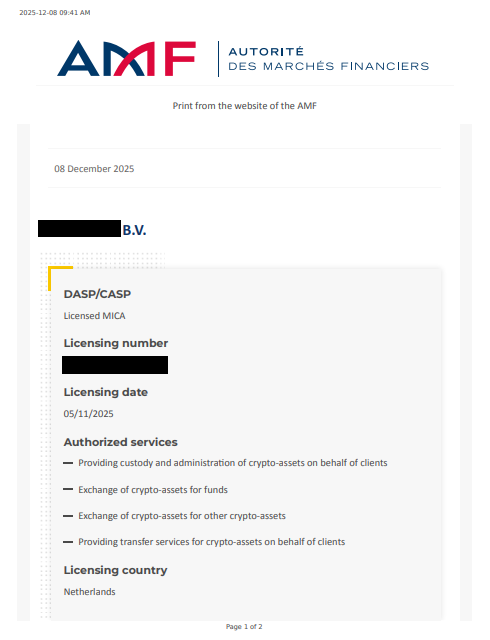
We reviewed the exchange activity in detail before discussing jurisdiction. The platform operated as a trading venue, exchanged crypto for fiat, and exchanged crypto for crypto. That meant CASP authorization was required under MiCA, with no real ambiguity about the regulatory classification.
We also checked the token universe. Because the platform did not deal in asset-referenced tokens or e-money tokens, the file stayed in the CASP lane rather than expanding into issuer-level issues.
What we assessed
- Service classification under MiCA
- Asset scope and token taxonomy
- Governance structure and fit-and-proper readiness
- Capital requirements and where the own funds sat
- Existing AML/KYC documentation and how much could be reused
Supporting Documents
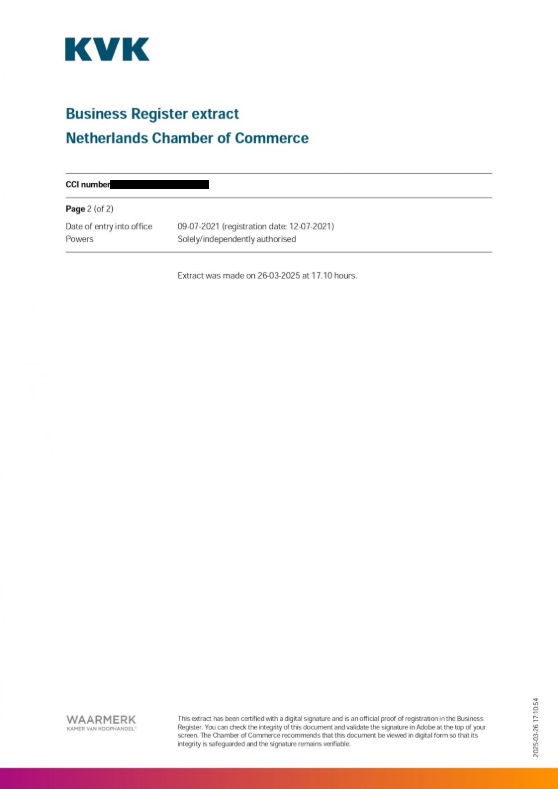
Selected redacted documents from the MiCA authorization file and post-authorization supervisory record.
Jurisdiction Comparison
The Dutch route was selected after comparing the main EU alternatives against the client profile.
| Jurisdiction | Supervisory profile | Processing pace | Commercial fit |
|---|---|---|---|
| Netherlands | DNB / AFM, established crypto track record | Thorough but navigable | Best fit for institutional credibility and genuine establishment |
| Lithuania | High-volume, efficient | Faster | Useful, but less aligned with the client’s long-term positioning |
| Germany | Rigorous and slow | Slower | Strong reputation, but heavier timeline pressure |
| France | Demanding and engaged | Moderate | Good regulatory depth, but more intensive dialogue |
What This Case Study Demonstrates
The Dutch authorization was only the midpoint. After approval, passport notifications were filed for the remaining target markets and the client moved into a continuous MiCA operating model with annual reporting, material-change notifications, incident reporting, and AML/CFT supervision.
Three decisions made the outcome possible:
- Choosing the Netherlands for the right reasons. The jurisdiction was selected for regulatory credibility, establishment logic, and banking/institutional utility, not just for speed.
- Engaging in-country counsel from day one. Daan H. helped translate EU-level rules into a workable filing strategy and kept the regulator interaction grounded in Dutch supervisory practice.
- Treating the application as a governance project. The file worked because the management body, policies, capital, and operational controls were built to function together.
What changed most was the compliance posture. The business moved from fragmented local registrations and informal control habits to a single regulated framework with clearer ownership, clearer evidence, and a better basis for future supervisory dialogue.
All corporate documents, regulatory correspondence, and personal information referenced in the case were anonymized or redacted to protect confidentiality.
Why Regulated United Europe?
Regulated United Europe OÜ (RUE) is a European legal consulting firm specializing in financial licensing, company formation, and regulatory compliance. Since 2016, we have helped hundreds of businesses obtain crypto, gambling, forex, and EMI/PSP licenses across 35+ jurisdictions.
With offices in four EU countries and a team of experienced lawyers, we provide end-to-end support — from initial consultation and company registration to license acquisition and ongoing compliance management.
500+
Clients Served
35+
Jurisdictions
Since 2016
Years in Business
4
EU Offices
Licensed Legal Practice
Fully registered and regulated EU company with partnerships across major financial centers.
Multilingual Team
Our experts speak English, German, Russian, Chinese, and 12+ other languages for global client support.
Turnkey Solutions
From company registration to license acquisition and compliance — we handle the entire process end-to-end.
Dedicated Support
Personal consultant assigned to each client. Direct communication channels, no call centers.


