6 Key Takeaways from This Article
The client started with no regulatory footprint
Client A approached Regulated United Europe with a brokerage concept, a partner with compliance experience, and a budget, but without a licensed entity, compliance file, or banking structure.
Mauritius won after a structured jurisdiction comparison
The choice was made by comparing seven jurisdictions across capital requirements, timing, annual costs, and market-access credibility rather than by chasing the cheapest offshore route.
The corporate wrapper was part of the licensing strategy
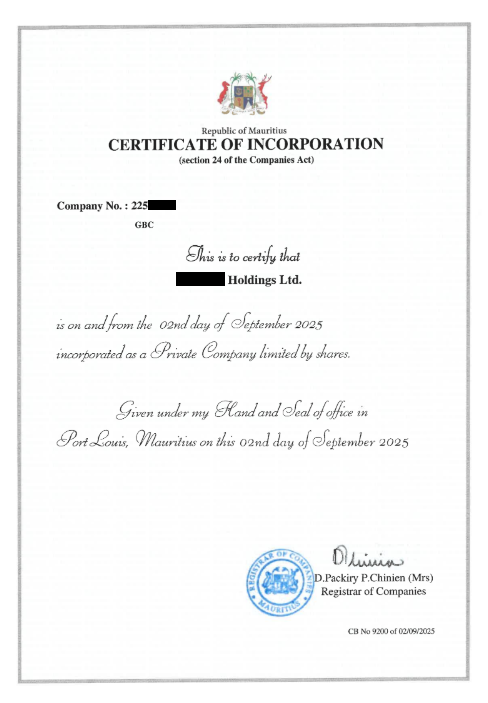
We built a Mauritius Global Business Company with the right resident directors, compliance function, and ownership chain before the FSC application was submitted.
The FSC file had to be built for scrutiny, not for formality
The business plan, AML/CFT materials, financial evidence, and personal files were drafted to answer the FSC's actual review points, including conflicts of interest and source-of-funds questions.
The result was a licence plus an operating model
After approval, the work continued into banking, segregated client-funds arrangements, MT5 setup, onboarding tools, and liquidity introductions so the brokerage could actually go live.
FSC queries were resolved without redesigning the file
Because the application was prepared around the FSC's real review points, the follow-up queries on conflicts of interest and source of funds were answered quickly without changing the core structure of the licence file.
From Brokerage Concept to a Mauritius Investment Dealer License
In early 2024, a prospective client whom we refer to here as Client A contacted Regulated United Europe with a clear commercial ambition: launch a regulated retail forex brokerage for clients in Asia and the Middle East. The trading concept was already defined, including an MT5-based setup and a hybrid B-book/A-book execution model, but the legal and regulatory foundation did not yet exist.
What they had was commercial clarity. What they lacked was everything the regulator and counterparties would actually review: the jurisdiction decision, the licensed entity, the compliance framework, the capital plan, and the banking structure for client funds.
The project therefore had to solve two problems at once. First, we had to obtain a credible licence within the client’s budget and timing constraints. Second, we had to make sure the licensed company could function immediately after approval instead of becoming an empty corporate shell.
What the Client Already Had
- A defined brokerage model based on MT5 and a hybrid B-book/A-book approach
- A partner with relevant compliance experience
- An overall launch budget of approximately EUR 200,000
- A target go-live window of roughly 6 to 8 months
- A commercial focus on Asia and Gulf-region clients
What the File Still Needed
- A jurisdiction that fit the target markets, capital budget, and review timeline
- A Mauritius licensed entity with real local substance
- An FSC-ready business plan, AML/CFT framework, and corporate file
- Capital evidence and a banking path for both operations and client funds
- A post-licensing setup covering reporting, technology, and liquidity
Core Strategy
This was not handled as a generic offshore incorporation. We treated the matter as a regulator-facing buildout in which the jurisdiction analysis, ownership chain, resident personnel, business plan, capital evidence, and future operations had to reinforce each other.
That sequence mattered. A forex file can be formally complete and still fail commercially if the banking path, client-funds structure, and operational disclosures do not make sense to the regulator and counterparties reviewing the business after licensing.
How the Matter Was Run
Scope the brokerage model and project constraints
Before recommending any jurisdiction, we ran a structured onboarding interview to understand how the brokerage would actually operate. The hybrid B-book/A-book model had implications for capital planning, conflicts-of-interest disclosures, and how the business plan needed to present execution practices to the regulator.
We also tested whether the commercial goals matched the legal reality. The client wanted credibility with payment processors and liquidity providers, needed to be operational within 6 to 8 months, and had a total project budget that ruled out high-capital European investment-firm routes.
What we assessed
- Whether the target business model could be presented cleanly from a regulatory perspective
- How the chosen markets in Southeast Asia and the Gulf would affect banking and counterparty due diligence
- Whether the available capital could cover licensing, incorporation, legal work, and minimum capitalisation
- Which jurisdictions were immediately out of scope because of timing or capital intensity
Supporting Documents
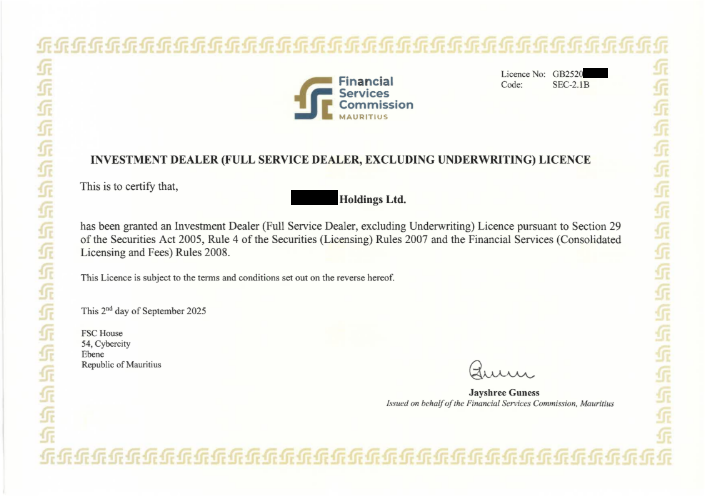
Selected redacted documents from the incorporation, licensing, and approval stages of the Mauritius matter.
Jurisdiction Comparison
Mauritius was selected after comparing the realistic licensing routes against the client's budget, timeline, and market-access needs.
| Jurisdiction | Regulator | Min. Capital | Avg. Timeline | Annual Fees | Market Access | ||||||||||||
|---|---|---|---|---|---|---|---|---|---|---|---|---|---|---|---|---|---|
| Cyprus | Cyprus Securities and Exchange Commission (CySEC) | Generally EUR 750,000 for an investment firm authorised to deal on own account, including relevant market-making brokerage models | Subject to regulatory review and application completeness | Application and ongoing supervisory fees apply | EU/EEA passporting for authorised investment services, subject to applicable notification procedures | ||||||||||||
|
Under Regulation (EU) 2019/2033 and Directive (EU) 2019/2034, the initial capital requirement for a Class 2 investment firm authorised to deal on own account is generally EUR 750,000. Lower initial capital requirements may apply to investment firms providing a more restricted range of services without dealing on own account. The appropriate capital category must be determined according to the specific investment services, activities and permissions requested. The historical EUR 730,000 capital figure should therefore be updated. |
|||||||||||||||||
| Belize | Financial Services Commission (FSC) | Capital requirements depend on the applicable securities business licence and authorised activities | Processing time depends on the application and regulatory assessment | Application, licence and ongoing compliance fees apply | International activities are subject to local and destination-country restrictions | ||||||||||||
Belize — Current Regulatory FrameworkThe International Financial Services Commission (IFSC) is the former name of Belize's financial services regulator. The current authority is the Financial Services Commission (FSC). The regulatory framework for securities and investment business includes the Securities Industry Act, 2021, the Securities Industry Regulations, 2023, and applicable amendments. The USD 500,000 capital figure originated under the former IFSC regime and should not be presented without qualification as the current minimum capital requirement for every Forex brokerage business. Applicants must determine the appropriate licence category, authorised activities, financial requirements and operational obligations under the current legislation. A licence issued in Belize does not automatically authorise a broker to solicit or serve clients in other countries. |
|||||||||||||||||
| Mauritius | Financial Services Commission (FSC) | MUR 1,000,000 for an Investment Dealer (Full Service Dealer excluding Underwriting), subject to the precise licence category and regulatory conditions | No guaranteed statutory processing period; actual timing depends on the application and FSC review | Regulatory application and annual fees apply | Cross-border services subject to destination-country laws | ||||||||||||
Capital Requirements for Forex Brokers in MauritiusThe minimum capital requirement for a Mauritius investment dealer depends on the licence category and the activities the applicant intends to perform. Under the Securities (Licensing) Rules 2007 and the FSC's published licensing criteria, the principal minimum stated unimpaired capital requirements include:
The regulatory capital requirement should not be confused with the overall cost of establishing and operating a licensed Forex brokerage. Additional financial resources may be necessary for personnel, premises, technology, compliance, professional services, liquidity arrangements and ongoing operations. The FSC also assesses whether the applicant has sufficient financial resources for its proposed business activities beyond the statutory minimum. Therefore, USD 250,000 should not be presented as the universal minimum capital requirement for obtaining a Forex brokerage licence in Mauritius. |
|||||||||||||||||
| BVI | FSC BVI | USD 100,000 | 6-9 months | Medium | Moderate | ||||||||||||
| St. Vincent and the Grenadines | Financial Services Authority (FSA) | No domestic Forex brokerage licensing framework | Company incorporation timeframe is not equivalent to a Forex licensing period | Company registration and maintenance costs apply | Incorporation does not confer regulated Forex brokerage status | ||||||||||||
St. Vincent and the Grenadines — Important Regulatory DistinctionThe Financial Services Authority of St. Vincent and the Grenadines does not issue licences authorising companies to conduct Forex trading or Forex brokerage activities. Registering a Business Company or Limited Liability Company in St. Vincent and the Grenadines does not constitute the acquisition of a Forex licence. In its public notice dated 3 February 2022, the FSA explicitly clarified that Forex trading and brokerage activities are not licensed in the jurisdiction. An entity incorporated in St. Vincent and the Grenadines must obtain any authorisation required in the jurisdiction where it actually conducts its regulated business. Therefore, company incorporation in St. Vincent and the Grenadines should not be compared with the acquisition of a regulated Investment Dealer licence in Mauritius, Cyprus or another jurisdiction operating a financial services licensing regime. The relevant comparison is between an unlicensed corporate structure and a separately authorised investment business. |
|||||||||||||||||
What This Case Study Demonstrates
Client A approached Regulated United Europe with a proposed Forex brokerage model, an initial budget and no existing financial services authorisation.
The project involved assessing licensing jurisdictions, establishing a Mauritius corporate structure, preparing regulatory documentation and addressing the Financial Services Commission’s requirements.
According to the case timeline, the licensing project progressed from the initial consultation to issuance of an Investment Dealer authorisation in approximately 24 weeks.
The reported outcome should be understood as specific to this project and dependent on the completeness of the application, the regulatory category, the applicant’s financial resources and the FSC’s assessment.
Following authorisation, the brokerage also required appropriate banking arrangements, client fund protection procedures, trading infrastructure, customer onboarding controls and ongoing regulatory compliance.
A Mauritius Investment Dealer licence authorises only the activities specified in the applicable licence and does not independently permit unrestricted provision of investment services in other jurisdictions.
Future applicants should not interpret the timeframe, budget or regulatory outcome of this case as a guarantee that similar results will be achieved in their own circumstances.
Three decisions made the outcome possible:
- Selecting the jurisdiction for commercial fit, not for marketing appeal. Mauritius was chosen because it balanced credibility, capital burden, review timing, and downstream processor acceptance better than the alternatives.
- Designing the structure before drafting the file. The resident directors, compliance role, ownership chain, and banking plan were treated as licensing inputs, not as paperwork to retrofit after submission.
- Managing the whole ecosystem instead of only the application form. Incorporation agents, local company secretaries, banks, technology providers, and liquidity partners had to be coordinated against one critical path.
The practical lesson is straightforward: a forex licence becomes materially easier to obtain when the business plan, governance model, disclosures, capital evidence, and post-licensing operations are built as one operating system. That is what shortened the review cycle and reduced the need for structural amendments after submission.
All corporate documents, correspondence, and personal information referenced in this article were anonymised or redacted to protect client confidentiality.
Why Regulated United Europe?
Regulated United Europe OÜ (RUE) is a European legal consulting firm specializing in financial licensing, company formation, and regulatory compliance. Since 2016, we have helped hundreds of businesses obtain crypto, gambling, forex, and EMI/PSP licenses across 35+ jurisdictions.
With offices in four EU countries and a team of experienced lawyers, we provide end-to-end support — from initial consultation and company registration to license acquisition and ongoing compliance management.
500+
Clients Served
35+
Jurisdictions
Since 2016
Years in Business
4
EU Offices
Registered European Legal Consultancy
Regulated United Europe OÜ is a company registered in Estonia that provides legal and regulatory consulting services, including company formation, financial services licensing support and corporate compliance advisory services.
Where a particular matter requires representation by a locally admitted advocate or another regulated legal professional, RUE may cooperate with appropriately qualified independent lawyers and professional partners in the relevant jurisdiction.
Company registration must not be confused with authorisation to practise law as a regulated advocate or law firm.
Any claim concerning professional legal practice authorisation should identify the relevant licensed individual or legal entity and the competent professional regulatory authority.
Multilingual Team
Our experts speak English, German, Russian, Chinese, and 12+ other languages for global client support.
Turnkey Solutions
From company registration to license acquisition and compliance — we handle the entire process end-to-end.
Dedicated Support
Personal consultant assigned to each client. Direct communication channels, no call centers.