People have been arguing with each other since they lived in caves. There was no money in those days, and the bet was on material things – weapons, household utensils, cattle, and later, in the slave trade, and slaves. The first sporting events began in antiquity. First Olympic Games in Ancient Greece took place in 776 BC. Then, the most widespread bets were placed on gladiatorial combats, races, and chariots. Archaeologists have found fragments of manuscripts testifying that around the fifth century BC and the first prototype of the tote appeared. Also, there was a set of rules about taking bets.
There were gladiator fights in ancient Rome, and with them, in arenas, there were people who argued for the victory of their favourite. In the harsh Roman law, there was a law called Lex aleatoria – from alea, which means dice. It is considered the first law about bets. Even then, in the III century BC, the gambling was forbidden, but sport bets were allowed.
Later European monarchs issued decrees, attesting to the development of gambling and gambling. King Louis I of France in 1254 issued an edict forbidding gambling on the territory of the country on pain of whipping. In 1710 Queen Anne of England declared debts at «a matter of honour» without legal consequences.
First bookies

The evolution of betting and gambling was on its way, and its natural stage was the emergence of bookmaking. Richard Tattersaul first began taking bets in 1766 and William Ogden in 1790. The odds were set between the bet and the win of each horse: thus the first odds appeared. A long time, the development of rates took place on the racetracks. Racing was the most popular entertainment on both sides of the Atlantic Ocean. Similar organizations soon appeared in France and the United States, as well as other countries.
Bookmakers’ activity wasn’t regulated by a law in those years. It meant that the clients depended on the honesty and decency of the bidders. In 1850, Leviathan Davis and Fred Swindell opened the first bet shop in London. The sports forecast was done by its founders who distributed leaflets with the chances of win.
Joseph Oller is generally claimed to be the owner of the very first betting pool. In 1865, he opened a central cashier in Paris in order to take in mortgages from players. This venture was quite successful and brought other similar funds into operation. In the last quarter of the 19th century, laws governing betting were passed in France, Great Britain, and other countries.
From Racecourses to Online Betting
In 1923, Littlewoods was established in Liverpool, California, and started taking bets by mail. Treble Chance was the best-known game where players could make 10, 11, or 12 forecasts for football matches over the coming weekend. Littlewoods was one of the world’s largest private companies until online betting gained momentum.
In 1934, William Hill was founded in London as the most popular betting company in the world. Until the middle of the 20th century, bookmaking continued to be semi-legal, and all that time the bettors were deprived of legal protection.
The very important year, as related to betting, was in 1961 because it was the year when the UK legalized betting in a form on May 1. More than ten thousand betting houses had opened that year in this country only. Betting has gained rapid popularity all over the world. Almost all sports and even unsporting events have been accepted by the bookmakers.
Online betting
In the year 1996, the first bet was made online. It was hosted by Intertops-an online licensed betting company of the small island Caribbean state of Antigua and Barbuda. In 1994, that country received the right as an offshore zone from the WTO to issue licenses for this kind of activity. In the future, other companies preferred to be kept offshore due to tax breaks. By 2001, the total value of the online sports betting market had grown past two billion dollars, and the total numbers of players had grown to eight million. In 2002, the first live bets by betors became possible.
Intertops has also been in the forefront in introducing mobile phone betting applications. In 2000, it launched the first software to enable online betting from mobile phones.
Sports betting market size
A consulting company, Zion Market Research, has concluded a study that the world’s online sports betting market may overcome $150 billion in 2024. It has also been found that sports betting now covers more than 70% of the global gambling industry. The biggest turnover of money is observed in football betting, the second place on this list is baseball.
Earnings from the gambling market in Europe
According to the, in 2019, the general
European gambling
market was estimated at 98.6 billion euros, gross gaming income, of which the share of online gambling is 24.5 billion euros and land-based gambling is 74.1 billion euros.
In 2020, due to the influence of COVID, total revenues from games decreased by 23% to 75.9 billion euros, but the share of online gambling is expected to increase significantly by 7% to 26.3 billion euros of gross gaming income.
Overall gambling revenue in Europe is forecasted to reach €111 billion in 2025 and with more than 33% online gambling.
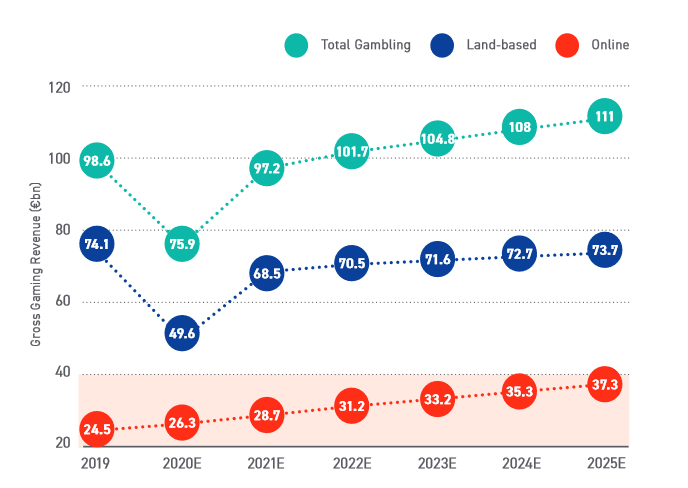
The online gambling market in Europe is growing in a regulated manner.
Research shows that the share of regulated/legal gambling in Europe is also increasing.
In 2019, Europe had an online entry rate of 73.5%, so nearly three quarters of online gaming activity took place in the regulated market, while 26.5% of activity was in the grey and black markets. Online gambling market share is expected to increase by a growth of 80.1% in the year 2023.
Sports betting – the most popular type of online gambling in Europe
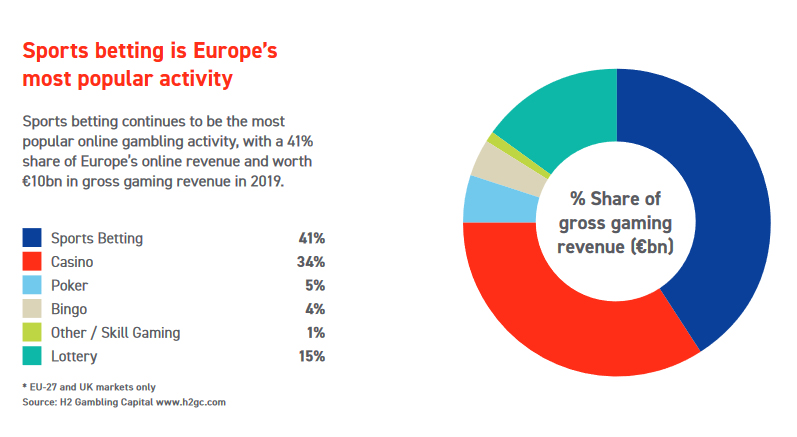
Sports betting still accounts for the largest share of online gambling revenues, 41 percent, and ten billion euros GGR in 2019.
- Sports Betting 41%
- Casino 34%
- Lottery 15%
- Poker 5%
- Bingo 4%
- Other / Skill Gaming 1%
European online gambling becomes mobile
This is low compared to other key markets. In 2019, 55.9% of online bets in Europe came from desktops, and only 44.1% of online bets came from mobile devices. By 2025, a further shift to mobile rates is expected and projected to be 58.2% of all online betting.
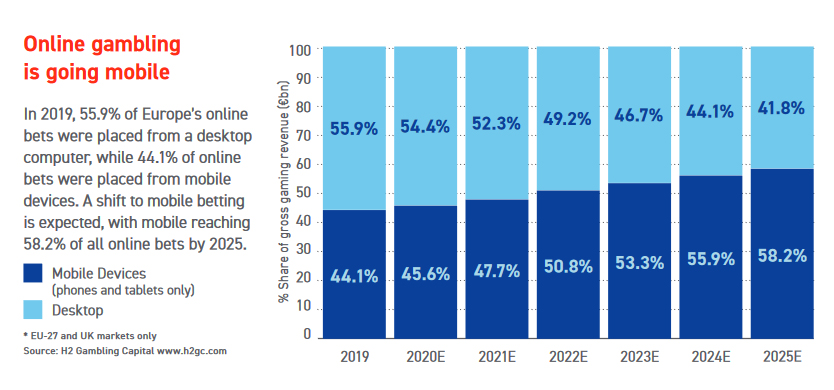
Table References: European Online Gambling Key Figures 2020 Edition
Biggest sports betting
| Rank | Bettor | Year | Bet Amount | Team | Outcome |
|---|---|---|---|---|---|
| 5 |
Charles Barkley |
2002 | £647,000 | New England Patriots | Bet won |
| 4 | Anonymous | 2018 | £1.2 million | Philadelphia Eagles | Bet won |
| 3 | Dave “Vegas” Oncha | 2015 | £2 million | Kansas City Royals | Bet won |
| 2 | Billy Walters | 2010 | £2.8 million | New Orleans Saints | Bet won |
| 1 |
Floyd Mayweather |
2014 | £8 million | Denver Broncos | Bet lost |
Future of the betting world
As experts admit, after the transition to online format, the work of many bookmakers became more transparent. However, at the same time, the players often complain about refusing to pay winnings by bookies. In turn, bookies report failures of software or suspicious activity in the profile. Therefore, the task of building more transparent models is relevant.
In the future, bets can be transferred to blockchain technology. This kind of technology will make this activity more transparent because all transactions are able to be tracked down quickly in the future. According to many journals, in the near future it is possible that next developments will be quite active in: eSports, blockchain, and virtual reality.
The blockchain technology means that all the bets will be placed in some kind of special register. Accordingly, no alteration of results will ever be possible. According to experts, blockchain entirely excludes the human factor and the interference of third parties in the processing of bets made. The bookmakers who will make use of blockchain technology will be able to provide their customers with opportunities which did not exist before.
E-sport began to develop extremely fast. Experts are sure that this is a popular discipline, which in the nearest future can become Olympic. The market of cybersports now is estimated at about $ 900 million, and millions of users all over the world watch streams.
The popularity of tournaments constantly rises; hence, so does the growth of bets on such events. Some companies try to add an accent of sensation to introduce virtual reality. Unique technology by Get InThe Race managed to create an effect of presence in horse racing, which caused a real stir with many users.
In the majority of European countries, such activity has already been legalized, and a company can get all the necessary licenses. But still, the lion’s share of owners or beginners of online betting offices prefer licenses issued by offshore zones or countries with loyal regulation of gambling activities. Gambling lawyers from Regulated United Europe would advise start-ups to choose getting a
gambling license in Curacao
or
gambling license in Costa Rica
. The main reasons are the low price of permit documents and also the term of obtaining the necessary license.
Also, lawyers from Regulated United Europe provide legal services for getting a
Czech Republic crypto license
.
How the sports betting industry has evolved
Since the very development of civilisation, sports betting has come a long way from this primitive gambling entertainment to a high-tech and multi-billion dollar segment of the world economy. This article is an analytical review of the history of sports betting, the evolution and impact on modern business, outlining the key moments of development and foreshadowing future trends of the industry.
The forerunners of sport betting
Sportive bets appeared centuries ago when for the first time gambling competitions and sports performances started to attract the viewers’ attention not only as a kind of activity but also as a possibility to try their luck. The Olympic Games in Ancient Greece, gladiatorial fights in the Roman Empire—all these became a springboard for the development of betting as a social phenomenon.
The Industrial Revolution and sports betting
Along came the industrial age, with development of communication technology, the first steps were made towards organisation in sports betting. First in 19th century Britain, betting on horse racing became not only an immensely popular pastime but also a significant part of the national economy, thus giving a birth to modern gambling industry.
Technological evolution and globalisation
Until the end of the 20th century, the internet came and totally changed the way people could gamble. Internet betting sites made the process open to the mass market across the world, and the industry started to boom more than ever. Globalisation and digitalisation finally enabled companies to expand the market, offering bets on all sports from anywhere in the world.
Regulation and innovation
In the course of time and further development of the betting business, it became apparent that its regulating would provide a decent, transparent, and protecting way for participants. A number of countries have introduced legislative frameworks that regulate this activity. By all means, together with this trend, blockchain, AI, and other technological novelties began finding their application in this very industry, enhancing its security, analytics, and predictive capabilities.
Future of Sports Betting
It can be assumed that the prospects of the industry of sports betting look rather bright because there is a growing interest both in sport competitions and gambling. The involvement of modern technologies, such as virtual and augmented reality, is likely to create new perspectives for users and expand markets.
The development of sports betting is a representation of the evolution in continuous steps with changes in social behavior, technology, and economics. From simple gambling to a multi-billion dollar industry, sports betting remains a considerable part of global business because it offers both enormous opportunities for growth and challenges to regulation and innovation. It will continue further development in the future, which will include adaptation to new technological and social trends, remaining an important and dynamic sector of the global economy.
Biggest betting sites 2024
In 2024, the industry of sports betting continues its phenomenal growth, with millions of fans around the world participating. Amidst numerous betting companies present in the market, few have managed to outshine the crowd on the basis of size, innovation, and effect on the marketplace. To begin with, we review the biggest betting companies of 2024, their specific features, and what their formula for success was.

Bet365: एक नाम जो आॅनलाइन बेटिंग का पर्याय है
Bet365 is one of the biggest and most famous bookmakers in the world. Since its founding in 2000, the company has been developing consistently, allowing its customers to place bets on all kinds of sports—from football and tennis to horse racing and even dog racing. Its progressive attitude toward live bets and very good service have made Bet365 a favorite among millions of punters.

William Hill: Tradition and Innovation
William Hill is a bookmaker founded in 1934, one of the oldest on the planet. Due to this, through the years, it successfully adapted the strong, fully integrated traditional operation with the online platform within a changing market. A strong position in the UK, besides strategic expansion into the US market, has confirmed William Hill’s status among industry leaders.

DraftKings: Innovation milestone in fantasy sports world
From the very start, DraftKings was a fantasy sports provider back in 2012 until it rapidly seized the number one position in the US betting market. Introducing new technology and its mobile apps, DraftKings could expand into traditional sports betting products and win the hearts of US audiences and beyond.

Betfair: The Betting Exchange Revolution
Betfair changed the face of betting with its introduction of the concept of a betting exchange where the user could act both as a bettor and a bookmaker. The approach immediately gave Betfair an edge over others in the market, fuelling its growth. Strong positions both in Europe and Australia confirm the status of the company as one of the market’s innovators.

Pinnacle: Leader with the best odds
Pinnacle is widely recognized due to competitive odds combined with low margins, which makes it very popular among professional punters. The company creates an optimal betting environment by offering very high limits and low restrictions, placing Pinnacle in a very special position amongst bookmakers.
It is worth mentioning that sports betting has kept on changing, involving new technologies and enlarging its geography in the last years. The leading bookmakers of 2023 try to prove that innovations, quality of service, and strategic vision are the key factors which lead to success and market influence. These companies ensure a great sport betting experience and at the same time outline the face of the whole industry, defining its tendencies.
Why Regulated United Europe?
Regulated United Europe OÜ (RUE) is a European legal consulting firm specializing in financial licensing, company formation, and regulatory compliance. Since 2016, we have helped hundreds of businesses obtain crypto, gambling, forex, and EMI/PSP licenses across 35+ jurisdictions.
With offices in four EU countries and a team of experienced lawyers, we provide end-to-end support — from initial consultation and company registration to license acquisition and ongoing compliance management.
500+
Clients Served
35+
Jurisdictions
Since 2016
Years in Business
4
EU Offices
Licensed Legal Practice
Fully registered and regulated EU company with partnerships across major financial centers.
Multilingual Team
Our experts speak English, German, Russian, Chinese, and 12+ other languages for global client support.
Turnkey Solutions
From company registration to license acquisition and compliance — we handle the entire process end-to-end.
Dedicated Support
Personal consultant assigned to each client. Direct communication channels, no call centers.


