Regulated United Europe at SBC Summit Barcelona 2023
Regulated United Europe attended SBC Summit Barcelona 2023 to meet participants in the sports betting and iGaming industry and discuss the legal questions behind international market entry. The event brought operators, technology suppliers, payment businesses and advisers together at Fira de Barcelona Montjuïc. For RUE, it was an opportunity to connect gambling licensing and compliance work with the commercial and operational realities of the businesses we advise.
- Held on 19-21 September 2023 at Fira de Barcelona Montjuïc, Spain.
- RUE attended as a visitor and did not operate an exhibition stand.
- Our focus was gambling licensing, AML/CFT compliance and cross-border business structuring.
3 essential points
- An industry meeting point. SBC Summit Barcelona brought together businesses from across the gambling supply chain. Meeting operators, platform providers and payment specialists helped our team explore how licensing, customer verification, technology and commercial arrangements interact in a live business.
- A market-specific approach to expansion. An international platform needs a legal assessment of each intended market. The country of incorporation, the location of the operator’s licence and the countries where players are located may create different requirements. Those questions should be addressed before launch or expansion.
- A historical event with continuing relevance. The summit took place in 2023, before MiCA’s CASP regime became applicable and before Curaçao’s LOK reform entered into force. Its lessons remain useful, but current applications must follow today’s rules rather than the regulatory position discussed at the conference.
4 key figures
- Around 15,000 Attendees reported for the 2023 event
- 350 Exhibitors reported by the organiser
- 38,000 m² Show floor reported for the Barcelona edition
- 450+ Industry leaders contributing to the conference programme
Reading the figures
Figures refer to the event as a whole, according to SBC’s post-event report published on 5 October 2023. They are not figures for RUE’s clients, meetings or projects.
RUE at the Barcelona summit
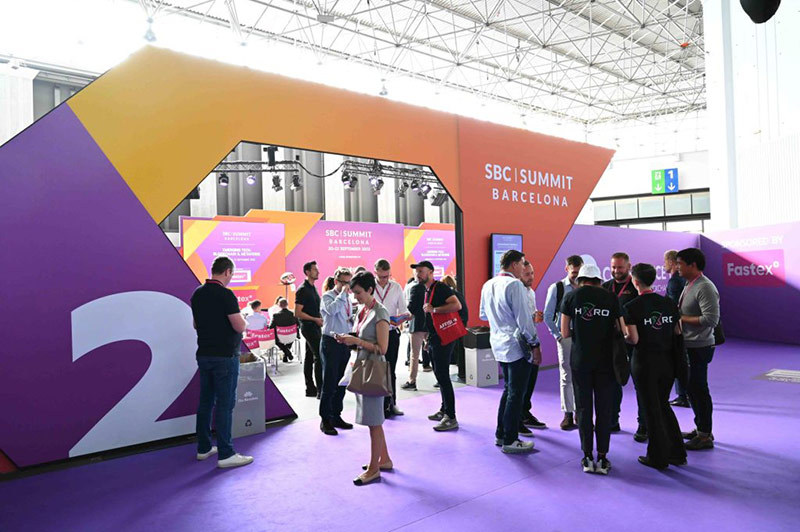
Our team participated through meetings and conversations across the exhibition and conference. Attending as visitors allowed us to focus on the questions raised by different parts of the industry: operators preparing to enter a new market, suppliers developing their products and service providers supporting international gambling businesses.
The programme covered sports betting, casino and iGaming, payments and compliance, affiliate activity and emerging technology. Bringing those areas together made it possible to consider a gambling business as a complete operating model. A platform decision can affect regulatory reporting; a payment arrangement can change customer due diligence; a marketing strategy can create obligations in a new country.
Why these conversations mattered
A useful licensing strategy begins with an accurate description of the business. Who contracts with the player? Which entity controls the account and holds player funds? Who supplies the games and manages the platform? Where will customers be located? Discussions with industry participants helped place these questions in their practical context.
For RUE, the value of the summit was the opportunity to listen to operational concerns and explain how legal preparation fits into commercial planning. A licence application is only one part of that work. Ownership, governance, supplier agreements, payment arrangements and the ability to maintain compliance after launch all need to be considered together.
Professional contacts and follow up
The event also provided opportunities to develop contacts with technology businesses, payment providers and other advisers. A productive follow-up starts by identifying the specific project, checking the proposed scope and agreeing the next steps. It should establish what assistance is required and which jurisdiction’s rules apply.
Participation in a conference creates an opportunity for that dialogue. Regulatory approvals remain the responsibility of the competent authorities, while an advisory relationship depends on the individual client’s needs and an agreed engagement.
Practical lessons for gambling businesses
The issues relevant to the Barcelona discussions continue to shape gambling projects. The following questions provide a useful starting point when assessing a new operation or an expansion into another market.
| Area | Questions to resolve before launch |
|---|---|
| Market access | Where are the players located, which products are permitted and what local permissions are required? |
| Business model | Is the business a consumer-facing operator, a platform supplier, a game provider or an affiliate? |
| Ownership and governance | Who owns and controls the applicant, who manages it and how are decisions documented? |
| AML and customer checks | How will the business assess risk, verify customers and respond to suspicious activity? |
| Player protection | How will age checks, self-exclusion, customer interactions and complaints be handled? |
| Technology and payments | Who controls the platform, records and funds, and how will suppliers support the applicable regulatory requirements? |
Licensing and incorporation serve different purposes
Registering a company establishes a legal entity. It does not, by itself, authorise that entity to operate an online casino or sportsbook. The required gambling permissions depend on the activity, the operating jurisdiction and the target markets. Corporate, tax and commercial registrations must therefore be assessed separately from gambling authorisation.
The European Union does not provide a single gambling operator licence that automatically grants access to every Member State. National licensing requirements remain important, and a licence issued in one country should not be treated as permission to solicit players everywhere. Advertising, product restrictions and player protection requirements also need a market-by-market review.
Great Britain illustrates the importance of the destination market: the Gambling Commission requires the relevant licence when a business provides remote gambling to British consumers, including where the business is based abroad.
Regulatory reference: Gambling Commission guidance for the remote sector
Technology needs a defined allocation of responsibilities
Software, analytics and automated checks can support compliance, but the operating arrangements must identify who reviews alerts, resolves exceptions and maintains the records. Contracts with platform and payment providers should reflect the actual division of responsibilities and the information the operator needs to meet its obligations.
The same applies to white label arrangements. Before choosing a provider, a business should establish who holds the relevant permissions, who contracts with customers, where the service may be offered and which tasks remain with the brand owner. A ready-to-use platform should be assessed alongside the legal and operational structure.
Regulatory developments since the 2023 event
This retrospective should be read alongside the changes that followed the conference. The most relevant distinction is between what was being discussed in September 2023 and the framework a business must use for a project today.
Gambling licensing frameworks
| Jurisdiction | Relevant framework and authority |
|---|---|
| Malta | The Malta Gaming Authority distinguishes B2C Gaming Service Licences from B2B Critical Gaming Supply Licences. The appropriate permission depends on the activities performed. |
| Curaçao | The LOK entered into force on 24 December 2024. The Curaçao Gaming Authority administers online gaming and supplier licensing under the reformed framework. |
| Isle of Man | The Gambling Supervision Commission administers online gambling licensing under the Online Gambling Regulation Act 2001. The proposed activities determine the requirements. |
Regulators: Malta Gaming Authority | Curaçao Gaming Authority | Isle of Man Gambling Supervision Commission
These examples describe regulatory frameworks, not a list of licences obtained by RUE or its clients. A new project requires an assessment of the relevant licence category, application requirements, target markets and continuing obligations.
Crypto payments and MiCA
MiCA entered into force in June 2023, but its CASP authorisation regime became applicable on 30 December 2024. Discussions at SBC Summit Barcelona therefore took place while businesses were preparing for that regime. The maximum EU transitional period for eligible existing providers ended on 1 July 2026.
A gambling business considering crypto payments should assess the services actually performed by each participant. Receiving a payment is not automatically the same as providing custody, exchange or another regulated crypto-asset service to a client. Gambling permission does not replace any separate crypto-asset or payment-services permission that the operating model requires.
Regulatory reference: ESMA overview of MiCA and its implementation
From Barcelona to later SBC events
The flagship SBC Summit moved to Lisbon in 2024. Barcelona 2023 remains a distinct event in RUE’s history; later editions have their own locations, programmes and participants. Our continued interest in industry dialogue centres on understanding business models, monitoring regulatory changes and maintaining useful professional relationships.
How Regulated United Europe can help
RUE supports gambling businesses with jurisdiction assessment, company structuring, licensing preparation and compliance documentation. The starting point is a review of the planned activities, target markets, ownership and operational arrangements. From there, we can define the scope of assistance and the professionals required for the project.
Regulated United Europe OÜ can assist with obtaining a gambling licence or assessing and implementing white label gambling solutions. Contact info@rue.ee to discuss your proposed business and the next steps.
Discuss a gambling licensing project
Assess the proposed business, destination markets, licensing route and the responsibilities of the operator and suppliers.